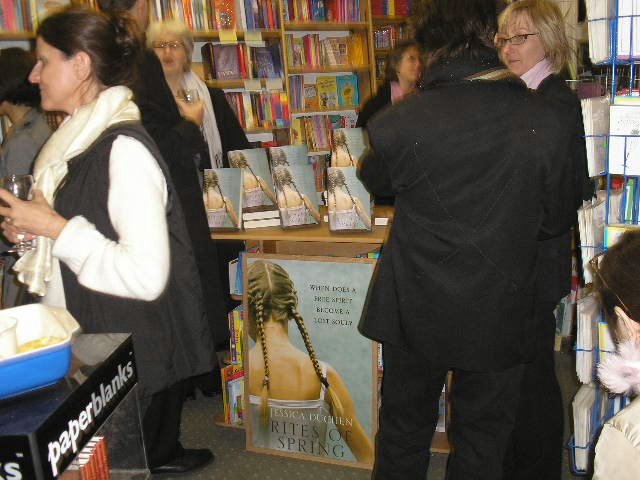
It's 13th March 2006. Publication day! As from now, my novel is available all over the Commonwealth, and that slot on the bookshelf that I spotted as a kid - somewhere between Drabble and Du Maurier - will at last be occupied by RITES OF SPRING. Is it possible to know, when you're 10 years old, that one day in 30 years' time there will be a 13th March 2006, there will be a book on a shelf, and the dream everyone says is just a dream will become real? Actually, if anybody had told me then, I'd simply have been horrified to think that it was going to take 30 years.
Tom, the lucky old thing, is in San Francisco today as the LPO is in the middle of a three-week tour of the US. Kurt Masur went off sick the day before the tour began, unfortunately (rumours of high blood pressure, which I can't confirm), and Osmo Vanska stepped in for the first few gigs, with Masur's assistant Minchuk taking over for the rest of California. I have 13th March all to myself here in London. It's a suitably spring-like morning: very cold, but bright, with that pale, silvery sunshine that's unique to March. What shall I do with my special celebratory day?
The answer is easy: get on with the next book.
Monday, March 13, 2006
Saturday, March 11, 2006
Author Compromised By Fiddle Passion
I can't believe I did this. But today I went against all my principles and bought The Daily Telegraph. It's a newspaper that I feel takes a political stance light years away from anything I find vaguely acceptable. But today was different, because - dreadful admission - I fell for the special offer.
How could I not? It was a 'free' DVD of INTERMEZZO. This movie, dating from somewhere in the 1940s, was Ingrid Bergman's first English-language film and it stars Leslie Howard as a famous Swedish violinist who falls in love with his daughter's piano teacher (Bergman). The first time I saw it was on TV one afternoon during the half-term holidays. I was about 16. My mother came home from work five minutes after it finished and gazed aghast at my red eyes and the heap of tissues on the floor. I had to explain that I'd just seen this movie where.......
But the ultimate pull of INTERMEZZO, for me, is the last word in slidey violins: a sound-track featuring Toscha Seidel. Seidel was a classmate of Heifetz's, studying with Auer: while Heifetz was described as the angel, Seidel was the devil. Guess which one has the hot sound, the burning tone, the passion that sings out that bit too far? Heifetz, beside Seidel, sounds cool as the proverbial cucumber.
Toscha had some measure of success, but was constantly overshadowed by Jascha's - though a song by George and Ira Gershwin about a bunch of leading violinists went 'Mischa, Jascha, Toscha, Sascha, we're four fiddlers three!' Seidel ended up in Hollywood, like so many amazing European musicians; and he recorded Korngold's suite from 'Much Ado About Nothing' with the composer at the piano (available on Biddulph Records). If you love Korngold for his emotional generosity and overblown, sensual heart, you will love Seidel too; and if you love slidey violins, you will find none slidier. Naturally, with my fiddle fetish, I can't resist him for a moment.
So, dear friends and editors forgive me, I compromised my reputation by buying the Telegraph. Rest assured, however, that I did not read it.
How could I not? It was a 'free' DVD of INTERMEZZO. This movie, dating from somewhere in the 1940s, was Ingrid Bergman's first English-language film and it stars Leslie Howard as a famous Swedish violinist who falls in love with his daughter's piano teacher (Bergman). The first time I saw it was on TV one afternoon during the half-term holidays. I was about 16. My mother came home from work five minutes after it finished and gazed aghast at my red eyes and the heap of tissues on the floor. I had to explain that I'd just seen this movie where.......
But the ultimate pull of INTERMEZZO, for me, is the last word in slidey violins: a sound-track featuring Toscha Seidel. Seidel was a classmate of Heifetz's, studying with Auer: while Heifetz was described as the angel, Seidel was the devil. Guess which one has the hot sound, the burning tone, the passion that sings out that bit too far? Heifetz, beside Seidel, sounds cool as the proverbial cucumber.
Toscha had some measure of success, but was constantly overshadowed by Jascha's - though a song by George and Ira Gershwin about a bunch of leading violinists went 'Mischa, Jascha, Toscha, Sascha, we're four fiddlers three!' Seidel ended up in Hollywood, like so many amazing European musicians; and he recorded Korngold's suite from 'Much Ado About Nothing' with the composer at the piano (available on Biddulph Records). If you love Korngold for his emotional generosity and overblown, sensual heart, you will love Seidel too; and if you love slidey violins, you will find none slidier. Naturally, with my fiddle fetish, I can't resist him for a moment.
So, dear friends and editors forgive me, I compromised my reputation by buying the Telegraph. Rest assured, however, that I did not read it.


Tuesday, March 07, 2006
In today's Indy
This is the tip of a Schumannish iceberg. It speaks more or less for itself, but I would like to thank everyone who took part and talked to me at such length about Schumann, Clara, the two of them and what really happened...
Friday, March 03, 2006
Wednesday, March 01, 2006
Spring(ish)
First of all, a big thank-you to All About Opera, which has kindly made this blog its Featured Site for the month of March. Quite apart from that, it's a useful, informative resource and all opera buffs should check in and explore it.
Brilliant sunshine here in London today. Perhaps spring is on the way at last, despite the snow in the north. Solti saw fit to leave the bed this morning and went outside for a whole two hours, so something must be changing.
Brilliant sunshine here in London today. Perhaps spring is on the way at last, despite the snow in the north. Solti saw fit to leave the bed this morning and went outside for a whole two hours, so something must be changing.
Tuesday, February 28, 2006
Viardot reborn
Last night I attended an extraordinary concert staged by Opera Rara and Prima Donna Productions at the Wigmore Hall: a programme with narration by Fanny Ardent about the life and music of Pauline Viardot, the great mezzo-soprano who inspired everyone from Chopin to Berlioz to Turgenev, whose lover she may or may not have been (this account, twinkle in eye, suggested the former). It was quite a marathon, starring three stunning singers: fabulous dramatic soprano Anna Caterina Antonacci, classic Russian bass Vladimir Chernov and the legendary Frederica von Stade, as radiant as ever and in fine form at 60 - remarkably, it was her very first appearance at the Wigmore.
The narration, written by Georgia Smith, was witty, informative and sensitive, even if Ardent didn't always sound comfortable speaking in English. If you're in Paris, try to catch the same concert at the Chatelet tomorrow, 1 March, presumably in French - it may go with a little more pizzazz. But the real star was Viardot's music. I've heard a number of her songs before, but many of yesterday's were new to me - heavens, they're beautiful! The variety is astonishing - she set poems in four or five languages, including Russian; and the warmth, melodic flow, drama, sensitivity to words and imaginative flair mean that, programmed alongside her admirers Gounod and Berlioz (his gorgeous La Captive, for mezzo-soprano, cello and piano) and her friend Chopin, her music more than holds its own. For me, top spot was the gorgeous Die Sterne, again with cello: breathtaking lyricism and a profound soul shone out of it.
Viardot has been a special interest of mine for a few years, but until now, I must admit, mostly because I adore Turgenev. I wrote a piece trailing this concert for the Indy which was in last week (read it here), but came away from the event itself feeling I'd discovered a new dimension to a story I thought I knew. This concert wasn't merely a rare music faction trying to convince us that second-rate music is worth hearing. Instead, it revealed a composer of real genius.
Opera Rara recorded the concert live and the CD will be released in due course. Grab it when you can and hear these unsuspected wonders for yourself.
UPDATE: 3 March 2006 - read The Independent's review by Robert Maycock here.
The narration, written by Georgia Smith, was witty, informative and sensitive, even if Ardent didn't always sound comfortable speaking in English. If you're in Paris, try to catch the same concert at the Chatelet tomorrow, 1 March, presumably in French - it may go with a little more pizzazz. But the real star was Viardot's music. I've heard a number of her songs before, but many of yesterday's were new to me - heavens, they're beautiful! The variety is astonishing - she set poems in four or five languages, including Russian; and the warmth, melodic flow, drama, sensitivity to words and imaginative flair mean that, programmed alongside her admirers Gounod and Berlioz (his gorgeous La Captive, for mezzo-soprano, cello and piano) and her friend Chopin, her music more than holds its own. For me, top spot was the gorgeous Die Sterne, again with cello: breathtaking lyricism and a profound soul shone out of it.
Viardot has been a special interest of mine for a few years, but until now, I must admit, mostly because I adore Turgenev. I wrote a piece trailing this concert for the Indy which was in last week (read it here), but came away from the event itself feeling I'd discovered a new dimension to a story I thought I knew. This concert wasn't merely a rare music faction trying to convince us that second-rate music is worth hearing. Instead, it revealed a composer of real genius.
Opera Rara recorded the concert live and the CD will be released in due course. Grab it when you can and hear these unsuspected wonders for yourself.
UPDATE: 3 March 2006 - read The Independent's review by Robert Maycock here.
Subscribe to:
Posts (Atom)