Michael Haas's Forbidden Music: The Jewish Composers Banned by the Nazis is being published on 7 May and is an absolute must-read for anyone with an interest in setting the record straight about the nature of music in the 20th century. It is, to the best of my knowledge, the first major scholarly book to address its specific question. I have a short feature about it in The Independent today.
Here to go with it is a spot of appropriate opera: Korngold, in longing-for-the-past mode. This is "Mein Sehnen, mein Wähnen, es träumt sich zurück" from Die tote Stadt - the Pierrot Tanzlied, sung in this (unfortunately uncredited) production by [shock] a Pierrot.
I'll never forget hearing Olaf Bär in Zurich having to sing this dressed in drag with basque, tights, six-inch black heels and butterfly wings, but that's another story.
Saturday, April 27, 2013
Friday, April 26, 2013
Sokolov plays Brahms, Prokofiev, Chopin and Rameau
Since Grigory Sokolov is not playing in Britain any time soon, and some people on our island appear never to have heard of Youtube, here is a little selection from his recitals. Perhaps he is a "pianist's pianist" or something, but I know of few pianophiles, pianists and serious fans who wouldn't go rushing to hear this man play anything he chose to play, anywhere, any time. The only other living pianists I'd mention in the same breath as him are Martha Argerich and Krystian Zimerman.
I was fortunate to interview him in 2006, in Barcelona, around midnight after an extraordinary recital. The article (for International Piano) is in my archive, here.
Brahms, live in Venice a couple of weeks ago:
Prokofiev Sonata No.7, 3rd movement 'Precipitato'
Chopin Polonaise-Fantaisie, from Amsterdam 2005 (audio only)
Rameau, 'La Poule'
I was fortunate to interview him in 2006, in Barcelona, around midnight after an extraordinary recital. The article (for International Piano) is in my archive, here.
Brahms, live in Venice a couple of weeks ago:
Prokofiev Sonata No.7, 3rd movement 'Precipitato'
Chopin Polonaise-Fantaisie, from Amsterdam 2005 (audio only)
Rameau, 'La Poule'


Boston tackles Wagner's Flying, er, Scotsman?

Tonight Boston Lyric Opera opens a new production of Wagner's The Flying Dutchman. Except that it isn't the opera as we know it: instead, it's an early version - the critical edition of 1841 - set in Scotland. The production is directed by Michael Cavenagh and stars Allison Oakes as Senta, Alfred Walker as the Dutchman, Gregory Frank as Donald [?? - sic] and Chad Shelton as Georg [EH? Ed. - yes, he is Georg, not Erik...] It is the US premiere of this version.
The British conductor David Angus, music director of BLO, is at the helm and I asked him a few questions about this distinctly unusual project for the Wagner bicentenary...
JD: David, please tell us
something about the differences between this version of The Flying
Dutchman and the one we usually hear? Are they obvious or subtle? Does it present any challenges that are significantly
different?
 DA: The
most obvious difference to the audience is the location - Scotland -
and the names of the characters. While this may seem superficial, the
music actually contains many references to Scotland, with the typical
bagpipe sounds of drones and little grace notes that underpin most of
the chorus music, and even form the melody lines. Apparently there are
even direct references to real Scottish folk songs, although I have not
yet managed to trace these. The ultimate authority on Scottish
Folksong, Marjory Kennedy-Fraser makes this claim.
DA: The
most obvious difference to the audience is the location - Scotland -
and the names of the characters. While this may seem superficial, the
music actually contains many references to Scotland, with the typical
bagpipe sounds of drones and little grace notes that underpin most of
the chorus music, and even form the melody lines. Apparently there are
even direct references to real Scottish folk songs, although I have not
yet managed to trace these. The ultimate authority on Scottish
Folksong, Marjory Kennedy-Fraser makes this claim.
The
point of all this is to understand that he really did write it with
Scotland in mind, and so the shift to Norway is not casual and
irrelevant.
The
musical changes are slight in the modifications for the first
performance. He transposed down the main aria for Senta which is
central to the whole piece, at the request of the soprano. It is not
easy to sing, even at the usual pitch, and up a tone, in A minor, is
really tough. However, it then makes a better contrast with the chorus
that precedes it, in A major, so we are sticking to his original higher
pitch. The orchestration is hardly altered for the 1843 version, but he
later made much bigger changes, in particular adding a sentimental
"redemption" ending to both the overture and the final scene. This
introduced the harp, at these two points only. The harpist sits there
the rest of the evening doing nothing! This Tristan style interruption
blocks the energy of the ending in both cases and holds things up for no
reason. It has no place in the piece as he first conceived it, and we
are not performing it.
For
me the biggest differences are that the standard version, as produced
in 1895 by Felix Weingartner, contains every added direction and
modification that anybody (not just Wagner) had thought to apply to
every performance in the first 50 years, and, on top of that, there has
grown a tradition of further modifications, to tempo in particular.
When you see the clean original score, it contains so little in the way
of directions that one hardly recognises it. To take just one example;
at the height of the development section in the overture, Senta's theme
appears no fewer than four times, with just a few bars between each.
There is not a single marking to identify this. In the later version
somebody, possibly Wagner, wrote Un poco ritenuto. What does
that mean to you? The tradition, which seems to have become so
ingrained that I could not find a single recording that didn't do it
(not even Roger Norrington or Bruno Weill on their "authentic"
performances), is to slam on the brakes and reduce the speed as little
as 1/3 of the main tempo! Hardly un poco ritenuto! You build up
the momentum, stop in your tracks for a few bars, and then set off
again at tempo for a few bars, only to screech to a stop again a few
bars later - and they do this 4 times in a row. Everybody does it!
Why? I just don't understand. One might argue that Wagner is quoted
as saying that each musical idea has its own natural tempo, but the very
same theme occurs immediately afterwards in the coda at an even higher
speed, without anybody every questioning it. We perform it without
losing momentum at all, and it works much better, maintaining the
forward thrust to the coda.
JD: In what ways does Wagner reflect the intended Scottish setting in the music? Did he keep any of those elements in the final, Norway-set version?
 JD:
How did the Scottish version come to light? What kind of editorial work
had to be done to it to make it performable? What attracted you to
the idea of staging it on in Boston?
JD:
How did the Scottish version come to light? What kind of editorial work
had to be done to it to make it performable? What attracted you to
the idea of staging it on in Boston?
My
New York manager mentioned that he had a client who had performed this
version in Australia many years ago, and it had been very successful.
At that time it had been uncovered by the conductor during his
research, and he had produced orchestral materials himself. I contacted
him and was persuaded to follow it up, only to find that Schott had
just produced a critical edition of this very version which had yet to
be performed in the US. You can imagine that, as I was already
interested in it, the idea that we could actually have a US premiere of a
major work by Wagner was an extremely attractive bonus. This year
there are so many Wagner performances that anything to help us stand out
is very valuable.
JD: The story goes that he changed the setting to Norway after a fearsome experience at sea when his ship was forced to shelter in the fjords from a North Sea storm, but do you think there is any other reason for his decision to change the setting?
 DA: There
are various theories, but he had already had that experience on his
journey to London and then Paris, before he wrote this piece, so it was
already in his mind when he composed it; he still set it in Scotland. I
believe the reason he later changed it was that he had begun to
construct the "lone creative giant" myth about himself - one of the
original "spin-doctors" - and decided to make the piece more
autobiographical. Maybe he also wanted to distance himself from his
sources - both the Heine original Scottish story and even his musical
influences such as Marschner's Der Vampyr (set in Scotland, in which a
pale man is redeemed by the death of an innocent girl!). Wagner's
original outline for the opera, set in Scotland, which he had sold to
the Paris Opera when they didn't want him to compose the whole opera,
had just been set by another composer, and I am sure he didn't want to
be associated with that.
DA: There
are various theories, but he had already had that experience on his
journey to London and then Paris, before he wrote this piece, so it was
already in his mind when he composed it; he still set it in Scotland. I
believe the reason he later changed it was that he had begun to
construct the "lone creative giant" myth about himself - one of the
original "spin-doctors" - and decided to make the piece more
autobiographical. Maybe he also wanted to distance himself from his
sources - both the Heine original Scottish story and even his musical
influences such as Marschner's Der Vampyr (set in Scotland, in which a
pale man is redeemed by the death of an innocent girl!). Wagner's
original outline for the opera, set in Scotland, which he had sold to
the Paris Opera when they didn't want him to compose the whole opera,
had just been set by another composer, and I am sure he didn't want to
be associated with that.
To
sum up, Wagner wrote a strong early Romantic opera, following directly
in the line of Weber (with whose music he had a great deal of direct
contact when growing up in Leipzig) but which he and his followers then
diluted by tinkering with it. It has ended up as neither the Musikdrama
(i.e. grand symphonic work, through-composed, and woven together with
leitmotivs) that it later aspired to be, nor the much more athletic and
punchy work that is was originally. I believe strongly that the
original version, shorn of all the "traditions" and modifications, is
much stronger.
I have been in contact with David Breckbill, the US authority on performance tradition in Wagner, and he wrote the following which makes a very clear case:
“To perform the Holländer as though it were a later work is to expose the younger
Wagner’s inexperience. Paradoxically, in
order to deserve equivalent status with its partners in the Wagner canon, Der fliegende Holländer requires
performers whose temperament, spontaneity, and technique can bring out the
fresh, vigorous qualities that set this opera apart from the later
“music dramas”, instead of assuming that a uniform performance style based on
the later works will bring the Holländer
closer to them.”
(David
Breckbill, Cambridge Opera Handbook)
JD: Not about Wagner, but we've all been following the Boston Marathon
bomb developments and have been thinking of you over there. How is
morale in the company and how is everyone feeling?
DA: Morale
is now good, because the show is going very well and we are all excited
to be doing our first big Wagner here. There was a general feeling
that nobody was going to let lunatics like that ruin our lives. The
bombs were awful, and caused chaos in Boston, as you will have heard.
We lost many important rehearsals, but everyone has done everything
they could to catch up and we are now back on track. We were all very
shocked at the time, but I also regret that this admittedly horrifying
event resulted in a worldwide media frenzy that will encourage every
terrorist organisation - showing how simple it is to shut down a major
US city twice in a week. If it had happened in Syria or Iraq, it would
hardly have been mentioned!
Photos by Eric Antoniou
Photos by Eric Antoniou

Thursday, April 25, 2013
Full speed ahead!
I sloped off to Vienna last week and was lucky enough to hear the lady in the cab above play the Tchaikovsky Violin Concerto at the Musikverein. Anne-Sophie Mutter is an unpredictable artist, someone who reimagines the music, pushes at all its boundaries - and occasionally, in the view of many, has been known to push too far. Yet her Tchaikovsky had a gratifying edge of danger: she never played one phrase "safe". And much of the finale really was full speed ahead... In terms of sheer technical perfection and fabulous tone, there is nothing she can't do. You may not like everything she chooses to do, but she commands absolute respect nontheless - and her Bach encore was impeccable in taste. She's a one-off.
In Vienna I also went to visit a few old friends...

Above, Haydn's house, his last home and now an excellent museum, well worth a dekko. Did you know he had a grey-and-red parrot? He brought it back with him from London and trained it to talk. After his death, when his effects were auctioned, it fetched a tidy sum.


Tuesday, April 23, 2013
"Jonas Kaufmann is an honorary Londoner"

Der Jonas's love-in with London continued as he scooped two prizes at the inaugural International Opera Awards last night. Commenting in The Evening Standard, which supported the event in association with Opera Magazine, the editor Sarah Sands praised London as a magnet for international levels of excellence and - while reminding us that we need to raise our own game to be able to compete in our own capital city - pointed to Kaufmann as a prime example of the world-class talent that comes here to shine.
"Pity the English tenors up against the winning German Jonas Kaufmann," she writes. "I watched him performing Verdi and Wagner at the Royal Festival Hall on Sunday and he was perfectly at ease with both composers and all nationalities. It is voice without borders...Jonas Kaufmann is an honorary Londoner now, as far as I'm concerned."Jonas himself, interviewed in the paper, makes straightforward and utterly pertinent remarks about why opera is for everyone. On the website, the Standard has a video of him receiving his prize.
Jonas won the Male Singer award and the Audience Prize. Other key awards included Nina Stemme for the Female Singer award, Sophie Bevan for Young Singer, Tony Pappano for Conductor, Dmitri Tcherniakov for Director, George Benjamin's Written on Skin for Premiere, Christian Gerhaher for CD, Oper Frankfurt for Opera Company and Sir George Christie of Glyndebourne for the Lifetime Achievement Award. The full list is here.
It's a warm, warm welcome from us and, one suspects, most of the music business to the UK's first full-scale prize glitter devoted entirely to opera. The more it can be celebrated, the more people hear about Jonas, Nina, Sophie and then hear their voices, the better. And if Jonas should ever decide he does want to become a Londoner, we'd be queuing up to show him the town.
May the Bard be with you!
It's Shakespeare's birthday today. It would also have been my mum's birthday. For them both, here are Korngold's Shakespeare Songs, sung by the incomparable Anne Sofie von Otter, with Bengt Forsberg at the piano. (If you've seen A Late Quartet, you may have spotted von Otter in a cameo role as the cellist's deceased wife, singing - appropriately enough - an extract of the Marietta Lute Song from Die tote Stadt.)
Monday, April 22, 2013
Jonas Kaufmann, swamped with red roses
So how can it happen that people go and schedule a Jonas Kaufmann concert at the Royal Festival Hall and a two-hander with Juan Diego Florez and Joyce DiDonato at the Barbican on the same flippin' night?
The fact that the inaugural Opera Awards are taking place tonight at the Park Lane Hilton, presenting prizes in 23 categories in front of 700 people, is probably a complete coincidence...
As it was, we had to choose, and I chose Kaufmann. There was Verdi and there was Wagner, and OK, it was one of those dates that pad out the sung programme with under-rehearsed orchestral extracts - but it was still Kaufmann.
He started off by charming everyone with a little speech about why he was using the music. He doesn't usually, he insisted, but he's had so much to deal with these past few weeks...and he didn't want us all to sit there watching him sweating and shaking and suffering, so...well, fair enough.
Wagner or Verdi, then, Jonas? Both, he says; and proceeded to prove that singing the one to near-perfection in no way precludes doing likewise for the other.
His Verdi selection was well planned, traversing the composer's development from the cod-Rossini idiom of the overture to Luisa Miller and the aria "Oh! Fede negar potessi...Quando le sere al placido"; through Simon Boccanegra - "O inferno!...Cielo pietoso, rendita" emerged as an absolute masterpiece in his interpretation - towards the ever-growing sophistication of Don Carlo ("Io l'ho perduta....Io la vidi") to La forza del destino ("La vita è inferno all'infelice...O, tu che in seno agli angeli").
This Verdi singing had everything: unleashed power matched by ever-alert nuance, tender covered tone balancing taut rhythms, expressive enunciation colouring mellifluous phrasing. Above all, Kaufmann's identification with the drama came across as utterly genuine. Many of these arias were pieces most of us have not heard him sing before. Therefore much anticipation had focused upon what he'd do with them; and he did not disappoint.
The Wagner extracts, though, are all on his recently-released album (of course) - and in some cases his performance even exceeded the achievements of the CD. The extremely extended Siegmund cries of "Wälse" suffer on the disc from a little drifting intonation, but not for a moment yesterday. Precision, power, character, colour, intelligence and that unmatchable, unmistakeable Kaufmann tone: it was all there and who could ask for anything more?
The special truc about Kaufmann is that he is a musician first and foremost: one who expresses his innate, sterling-quality musicianship through a voice that happens to be a once-in-a-lifetime phenomenon. This is rare. And he can act; and he looks great. All of that is a bonus.
He brought us a powerful, bitter Siegmund, a disingenuous Walther "Am stillen Herd" (we longed for the Prize Song but didn't get it) and his magnificently tormented "Amfortas! Die Wunde" from Parsifal - the opera that works least well as bleeding chunks at any time. (Pictured: Kaufmann as Parsifal at the Met.) Yet of the whole programme, the Wagner encores stand out as the most cherishable moments: two of the Wesendonck Lieder, "Schmerzen" and "Träume", sung entirely as the Lieder they are rather than as opera manqué, the emphasis falling upon the poetry, the intimacy, the sensibility. And "Winterstürme" from Die Walküre brought us an assurance that after this awfully long winter, spring really had come at last.
So had the flowers. Rarely do we see a man showered with bouquets of red roses to this extent - brought to him on stage, but also handed to him from the audience. One lady trotted to the front with a red shiny bag to give him, content invisible. Let's hope it was chocolate. He deserved some.
The Florez/DiDonato concert sounds like a classier event, as far as peripheries are concerned - the RFH audience had to deal with a programme sprinkled with ridiculous misprints (Wagner was in the Dresden Uprising in 1949?), equally ridiculous summaries of entire opera plots yet no song texts, and huge pin-up style photos of our tenor (well, that's OK to some...). But all credit to the Philharmonia and conductor Jochen Rieder for delivering much better than the other orchestra did last time Kaufmann sang a Gubbay gig, even if - thanks, I fear, to the RFH acoustics, which have been infuriatingly biased against the treble ever since the refurbishment - the brass drowned the upper strings at every turn. A guest clarinet in the form of Andrew Marriner proved worth his weight in gold.
UPDATE, 3.40pm: There was a fourth encore. It was Verdi's 'Ah, la paterna mano'. I missed it. I thought it was all over...Fortunately, though, someone filmed it and has put it on Youtube. Here it is.
Sunday, April 21, 2013
A Sunday round-up
The trouble with burning the candle at both ends is that while you're out and about, you're not writing. Therefore JDCMB is a little bit late with what follows.
Leif Ove Andsnes gave the same programme twice at the Wigmore Hall last week; I attended on the second night (11 April). Not sure what's with Beethoven Op.101 this season, but this was the fourth time I've bumped into it since October; this time it joined a mixed programme including Beethoven's Op.54, Bartok's Suite Op 14, an all-too-rare rendition of Liszt's 'Pensées des morts' from the Harmonies poetiques et religieuses and Chopin's C minor Nocturne and Fourth Ballade.
Andsnes has one of the most sheerly beautiful sounds to be found on today's pianistic platforms; a super-cool customer, personable and unpretentious, he plays as if in a trance, cocooned at the piano in a world of his own. There's an almost scary perfection about him - a sole wrong note came almost as a relief, as if to say, "ah, this guy is human after all". Yet it can be flummoxing to hear the rugged Op.101 and the ferocious folksiness of the Bartok sounding as smooth as butter and the Chopin Ballade so precisely navigated that there seemed little time to "stop and smell the flowers". That exquisite moment when Chopin enters an hypnotic state of enchantment - spinning out a few bars of melody over four-against-three ripples in an aural-optical illusion - disappeared into its own notes with no time to catch the light and shine.
Nevertheless, the C minor Nocturne, its melody shaped with microscopically precise sensitivity and beauty, giving way to a mingling of chorale and octave storms that sends the cantilena into a fever of overturned emotion, was perhaps the high point of the concert. A treat and a half to hear such playing at close quarters rather than in the huge RFH.
 Sunken Garden, ENO's world premiere from Grawemeyer Award-winning composer Michel van der Aa, took over the Barbican Theatre for a week.
Opera in 3D? Korngold once said, when he went to Hollywood, that some day whole operas might be written for the big screen; and here it was, with knobs on; one such knob being 3D specs that can be worn over your normal specs (v useful). As a 21st-century way of conceiving a musical stage work, mingling live performance with pre-recorded film including holograms of several singers who do not appear in the flesh, but with which the on-stage singers must interact, it's a presentation that needs - and received - the slickest and cleverest of integration in performance.
Responses have ranged from "this is the future", downwards. Several concerns. First of all, this opera has much in common with many "traditional" operas in that its story is so convoluted, and the enunciation of the (amplified) singers so unclear (except for the excellent Roderick Williams) that it was next to impossible to work out what was actually going on. Themes of conscience, cot death, euthanasia, afterlife, Dr Who-like self-projections, mystical oneness with the planet (think parachuting - but why?) - all mingle in David Mitchell's imaginative yet overstuffed libretto. We enter the Sunken Garden - actually the Eden Project - through a door under a motorway and find ourselves in limbo with some lost souls and an evil, or not, mastermind, or... hmm.
While the music undoubtedly has its moments - such as some memorable effects achieved by layering repetitive snatches of film and matching soundtracks - the number one requirement for a successful opera is that the music should be the best bit; the words should provide the runway from which it can take off and fly. Perhaps Sunken Garden's chief problem is that it is so busy dazzling us with its special visual effects that the aural element begins, inadvertently, to take second place. It is all hugely inventive and ground-breaking, significant indeed for the future of opera, yet not wholly successful in its own right.
The following night, Rustem Hayroudinoff played at St John's Smith Square, in an evening that had a fraction of the audience yet twice the impact (at least for us pianophiles). Rarely do you see the entire listening assemblage jump to its feet at the final note. This one did. The Rachmaninov Piano Sonata No.1 is rarely performed - probably because it is too difficult. It's a Faust Symphony for one instrument and ten fingers, and there is more extraordinary music in a single bar of it than in certain entire evenings of...well, you get the idea.
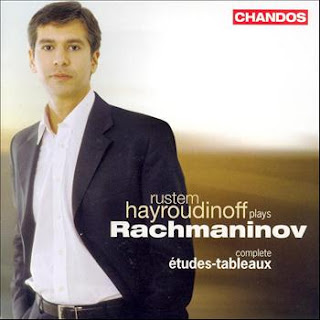 Rachmaninov weaves the work from a range of symbolic leitmotifs for different aspects of Faust, Gretchen and Mephistopheles (helpfully illustrated by Hayroudinoff in his spoken introduction). These pianistic textures would sound as complex on a 100-piece orchestra. As a feat of out-and-out virtuosity it is unremitting, indeed mind-boggling; but to deliver the wild flights of Rachmaninov's imagination with such colour, fidelity, rigour, fire and serious bedazzlement is a phenomenal achievement. Hayroudinoff's performance brought back to life the grand Chaliapin-inflected Russian style, with a depth of perspective in the voicing that was more convincingly 3D than anything we saw in that physically 3D opera.
If someone doesn't frogmarch him into a recording studio and insist that he records this gargantuan piece to add to his impressive roster of benchmark, award-shortlisted Rachmaninov discs, then those of us who were there last Saturday will simply have to throw tantrums until they do. Oh, and he also played some extremely fine Bach and Liszt - the small matter of the Second Partita and the Mephisto Waltz No.1 and more.
What price trouser-pressed perfection? What price technological novelty? All you need is one person, one instrument, music of genius and a performance infused with the fire of absolute inspiration, awareness and understanding. That is worth ten, probably a hundred, of anything else. That's what the musical experience is all about.
And with that little piece of profundity for a Sunday afternoon, I'm off to hear Jonas Kaufmann at the RFH.
Leif Ove Andsnes gave the same programme twice at the Wigmore Hall last week; I attended on the second night (11 April). Not sure what's with Beethoven Op.101 this season, but this was the fourth time I've bumped into it since October; this time it joined a mixed programme including Beethoven's Op.54, Bartok's Suite Op 14, an all-too-rare rendition of Liszt's 'Pensées des morts' from the Harmonies poetiques et religieuses and Chopin's C minor Nocturne and Fourth Ballade.
Nevertheless, the C minor Nocturne, its melody shaped with microscopically precise sensitivity and beauty, giving way to a mingling of chorale and octave storms that sends the cantilena into a fever of overturned emotion, was perhaps the high point of the concert. A treat and a half to hear such playing at close quarters rather than in the huge RFH.

Opera in 3D? Korngold once said, when he went to Hollywood, that some day whole operas might be written for the big screen; and here it was, with knobs on; one such knob being 3D specs that can be worn over your normal specs (v useful). As a 21st-century way of conceiving a musical stage work, mingling live performance with pre-recorded film including holograms of several singers who do not appear in the flesh, but with which the on-stage singers must interact, it's a presentation that needs - and received - the slickest and cleverest of integration in performance.
Responses have ranged from "this is the future", downwards. Several concerns. First of all, this opera has much in common with many "traditional" operas in that its story is so convoluted, and the enunciation of the (amplified) singers so unclear (except for the excellent Roderick Williams) that it was next to impossible to work out what was actually going on. Themes of conscience, cot death, euthanasia, afterlife, Dr Who-like self-projections, mystical oneness with the planet (think parachuting - but why?) - all mingle in David Mitchell's imaginative yet overstuffed libretto. We enter the Sunken Garden - actually the Eden Project - through a door under a motorway and find ourselves in limbo with some lost souls and an evil, or not, mastermind, or... hmm.
While the music undoubtedly has its moments - such as some memorable effects achieved by layering repetitive snatches of film and matching soundtracks - the number one requirement for a successful opera is that the music should be the best bit; the words should provide the runway from which it can take off and fly. Perhaps Sunken Garden's chief problem is that it is so busy dazzling us with its special visual effects that the aural element begins, inadvertently, to take second place. It is all hugely inventive and ground-breaking, significant indeed for the future of opera, yet not wholly successful in its own right.
The following night, Rustem Hayroudinoff played at St John's Smith Square, in an evening that had a fraction of the audience yet twice the impact (at least for us pianophiles). Rarely do you see the entire listening assemblage jump to its feet at the final note. This one did. The Rachmaninov Piano Sonata No.1 is rarely performed - probably because it is too difficult. It's a Faust Symphony for one instrument and ten fingers, and there is more extraordinary music in a single bar of it than in certain entire evenings of...well, you get the idea.
 Rachmaninov weaves the work from a range of symbolic leitmotifs for different aspects of Faust, Gretchen and Mephistopheles (helpfully illustrated by Hayroudinoff in his spoken introduction). These pianistic textures would sound as complex on a 100-piece orchestra. As a feat of out-and-out virtuosity it is unremitting, indeed mind-boggling; but to deliver the wild flights of Rachmaninov's imagination with such colour, fidelity, rigour, fire and serious bedazzlement is a phenomenal achievement. Hayroudinoff's performance brought back to life the grand Chaliapin-inflected Russian style, with a depth of perspective in the voicing that was more convincingly 3D than anything we saw in that physically 3D opera.
If someone doesn't frogmarch him into a recording studio and insist that he records this gargantuan piece to add to his impressive roster of benchmark, award-shortlisted Rachmaninov discs, then those of us who were there last Saturday will simply have to throw tantrums until they do. Oh, and he also played some extremely fine Bach and Liszt - the small matter of the Second Partita and the Mephisto Waltz No.1 and more.
What price trouser-pressed perfection? What price technological novelty? All you need is one person, one instrument, music of genius and a performance infused with the fire of absolute inspiration, awareness and understanding. That is worth ten, probably a hundred, of anything else. That's what the musical experience is all about.
And with that little piece of profundity for a Sunday afternoon, I'm off to hear Jonas Kaufmann at the RFH.
Lang Lang mobilises support for China's earthquake plight
He writes on his Facebook page:
Here's that link again: https://www.facebook.com/LangLangPiano
Saturday, April 20, 2013
A lost concerto from Hungary, 1942: world premiere ahead
Barnabas Kelemen, the brilliant young violinist from Budapest, wrote to me recently with an astonishing story. On 2 May at Carnegie Hall, New York, he is giving the world premiere of a violin concerto by the Hungarian composer Mihaly Nádor, who died in the Holocaust in 1944. It is part of a powerful programme from the American Symphony Orchestra under the conductor Leon Botstein: entitled 'Hungary Torn', it features world and US premieres of several works by Hungarian composers, including the US premiere of Dohnányi's Szeged Mass.
The Nádor Concerto dates from two years before its composer's tragic death. I asked Barnabas to tell us more about it...
 JD: Barnabas, how did the Violin Concerto by Mihaly Nádor come to light? And how did you come to be giving its world premiere?
BK: I got a phone call from my dear friend, the viola player Peter Barsony, who said that after years of research he had found several interesting pieces from Hungarian composers who suffered under the regimes of the first part of the 20th century. One of the most interesting was the Violin Concerto by Mihály Nádor, who died in the Holocaust in 1944 and finished his concerto in 1942. The manuscript was found in the Hungarian National Széchenyi Music Library. Leon Botstein, the concert's conductor, is always interested in this kind of repertoire, finding interesting music that hasn't been played, but is really worth learning. And they asked me would I be interested...? And I very much was and I'm just more and more enthusiastic about the piece!
JD: What is the music like? What do you enjoy most about it? Do you think it is a work that might enter the general concert repertoire now?
BK: The greatest thing about this concerto, first, is that it's a real
masterpiece. It's about 30 minutes long and there wouldn't be any part that
I'd like to cut out or change! Nádor himself was a violinist, but mainly
he was an operetta and film-music composer. He also composed several concert works. The piece is full of post-romantic
colours, with Nádor's own voice: very virtuoso, with some interesting
new ideas for violinists, many inspired by the Mid-European/Hungarian
styles. They say that as he finished the first movement in Munich he wanted
to premiere it, but at the end he had to confess that it was too
difficult for him and he wasn't able to play it! Truly the Violin Concerto
is equally as difficult as any of the greatest romantic violin
concertos, if not more virtuoso than some. I think if we compare the
piece to violin concertos by Goldmark, Walton, Elgar and Korngold, then
Nádor has the chance to be part of this - though no one has heard it,
so let's wait until the world premiere and the reactions...
JD: Do you think there are many more pieces by him waiting to be rediscovered and performed?
BK: Nádor was one of the best operetta and variete compsers of the
early 20th century after Lehár and Imre Kálmán, with some great
compositions for some of the famous movies of the '30s in Hungary. He
was a student of the Ferenc Liszt Music Academy, where I happen to teach
chamber music after being a violin professor for seven years. After
learning and world-premiering his great Violin Concerto I will surely
look into his repertoire what else I could play (indeed, premiere) as his concerto was a wonderful, great adventure in this style for me. Not
many violinsts can get to know a masterpiece in this style first in the
world and bring it to a premiere in Carnegie! It's a real honour that
Leon Botstein and the American Symphony Orchestra asked me to play this
concert in the Carnegie Hall, where I had the chance to play a recital
60 years after another Hungarian masterpiece had been premiered
there by Yehudi Menuhin, the Solo Sonata by Béla Bartók. This piece was
also on my recital's program in 2004.
JD: Do you have any plans for further performances or a recording?
BK: I'm seriously thinking about both the further performances of the
Nádor Violin Concerto and a recording, but first I'd like to perform
the piece. I can't wait to hear the orchestration, not only from looking
at the score. Hungary must take the Hungarian premiere very seriously!
The Nádor Concerto dates from two years before its composer's tragic death. I asked Barnabas to tell us more about it...
 JD: Barnabas, how did the Violin Concerto by Mihaly Nádor come to light? And how did you come to be giving its world premiere?
BK: I got a phone call from my dear friend, the viola player Peter Barsony, who said that after years of research he had found several interesting pieces from Hungarian composers who suffered under the regimes of the first part of the 20th century. One of the most interesting was the Violin Concerto by Mihály Nádor, who died in the Holocaust in 1944 and finished his concerto in 1942. The manuscript was found in the Hungarian National Széchenyi Music Library. Leon Botstein, the concert's conductor, is always interested in this kind of repertoire, finding interesting music that hasn't been played, but is really worth learning. And they asked me would I be interested...? And I very much was and I'm just more and more enthusiastic about the piece!
JD: What is the music like? What do you enjoy most about it? Do you think it is a work that might enter the general concert repertoire now?
JD: Do you think there are many more pieces by him waiting to be rediscovered and performed?
JD: Do you have any plans for further performances or a recording?
Friday, April 19, 2013
Proms 2013: Hear 7 Wagner Operas for £5 Each
You'll need sandiwches, water, strong shoes and even stronger legs - those operas are loooong - but where else in the world can you go to the complete Ring cycle conducted by Daniel Barenboim and starring Nina Stemme, plus Tristan und Isolde, Tannhauser and Parsifal, each with major Wagnerian superstars at the helm, and stand just a few metres from the performers, and pay only £5 a time? Yes, the Proms are back and this is one great whopper of a Wagner anniversary season.
There's some Verdi - though no complete operas (apparently this is down to it's-just-how-things-turned-out, rather than any Wagner-is-best conspiracy, before you ask). And a more than fair pop at Britten, including Billy Budd from Glyndebourne. Fans of Granville Bantock, Walton, Rubbra, George Lloyd and Tippett could also be quite happy with this year's line-up.
The glass ceiling is shattering nicely as Marin Alsop takes the helm for the Last Night, becoming the first woman ever to conduct it. Better late than never, and she is a brilliant choice for the task.
Guest artists on the Last Night include Joyce DiDonato and Nigel Kennedy. Nige will be appearing earlier in the season too, playing the good old Four Seasons with his own Orchestra of Life plus the Palestine Strings, which consists of young players from the Edward Said National Conservatories of Music. Lots of piano treats as well - soloists to hear include Jean-Efflam Bavouzet, the terrific duo of Noriko Ogawa and Kathryn Stott, Daniil Trifonov in the rarely-heard Glazunov Piano Concerto No.2 and Imogen Cooper and Paul Lewis playing Schubert's Grand Duo for piano duet in a late-night Prom.
There's one thing, though, that sent me into meltdown. Leafing through the listings, one turns to 6 August and out leap the words KORNGOLD: SYMPHONY IN F SHARP. I've waited 30 years for this. Erich Wolfgang Korngold's one and only full-blown symphony is coming to the Proms at long, long last. It is being performed by the BBC Philharmonic under John Stogårds. And guess what? I'm supposed to be away on holiday on 6 August. If that isn't the Law of Sod, then what is?
Meanwhile we're promised more TV coverage of the Proms than ever before, and plenty of stuff online, and the invaluable iPlayer to help with catching up. But really, there's no substitute for being there. If you've never been, get a taste of it in the launch film above. Book your tickets now.
Full listings here.
There's some Verdi - though no complete operas (apparently this is down to it's-just-how-things-turned-out, rather than any Wagner-is-best conspiracy, before you ask). And a more than fair pop at Britten, including Billy Budd from Glyndebourne. Fans of Granville Bantock, Walton, Rubbra, George Lloyd and Tippett could also be quite happy with this year's line-up.
The glass ceiling is shattering nicely as Marin Alsop takes the helm for the Last Night, becoming the first woman ever to conduct it. Better late than never, and she is a brilliant choice for the task.
Guest artists on the Last Night include Joyce DiDonato and Nigel Kennedy. Nige will be appearing earlier in the season too, playing the good old Four Seasons with his own Orchestra of Life plus the Palestine Strings, which consists of young players from the Edward Said National Conservatories of Music. Lots of piano treats as well - soloists to hear include Jean-Efflam Bavouzet, the terrific duo of Noriko Ogawa and Kathryn Stott, Daniil Trifonov in the rarely-heard Glazunov Piano Concerto No.2 and Imogen Cooper and Paul Lewis playing Schubert's Grand Duo for piano duet in a late-night Prom.
There's one thing, though, that sent me into meltdown. Leafing through the listings, one turns to 6 August and out leap the words KORNGOLD: SYMPHONY IN F SHARP. I've waited 30 years for this. Erich Wolfgang Korngold's one and only full-blown symphony is coming to the Proms at long, long last. It is being performed by the BBC Philharmonic under John Stogårds. And guess what? I'm supposed to be away on holiday on 6 August. If that isn't the Law of Sod, then what is?
Meanwhile we're promised more TV coverage of the Proms than ever before, and plenty of stuff online, and the invaluable iPlayer to help with catching up. But really, there's no substitute for being there. If you've never been, get a taste of it in the launch film above. Book your tickets now.
Full listings here.
Sunday, April 14, 2013
SIR COLIN DAVIS, 1927 - 2013
Goodnight, dear maestro. May flights of angels sing thee to thy rest.
Some memorials from JDCMB:
The big interview: http://jessicamusic.blogspot.co.uk/2012/03/when-jd-met-sir-colin-davis.html
Elgar Violin Concerto centenary performance with Nikolai Znaider & the LSO, 10 November 2010
Subscribe to:
Comments (Atom)